
Archives by date

You are browsing the site archives by date.

Why Mobility Matters

Why Mobility Matters

Subject: Mobility Matters (especially if you enjoy movements like walking, bending or looking over your shoulder 😜)

Hi friend, 

Can we talk mobility please? This (in my opinion) is the unsung hero of functional movement.

It is the stuff that helps us do everyday tasks without moving like our joints are Wi-Fi signals that have messed up connections. 

Here is why mobility actually matters for functional movement.


Mobility is your body’s ability to move a joint through its full, usable range of motion with control.


Mobility, 

  1. Makes your body move the way it was designed, not the way your desk job trained it.
    Sitting all day basically convinces your hips to retire early.
    Mobility wakes them back up so you can squat, hinge, twist, and reach like a fully updated human model.
  2. Helps you handle real-life movements with fewer surprises.
    Picking up groceries? Carrying laundry? Lunging to stop your phone from falling between the car seats (worst place on Earth)?
    Mobility makes these movements feel smooth instead of like, “please don’t pull something… please don’t pull something.”
  3. Improves your movement patterns so your workouts actually translate to everyday life.
    Strength is great, but if your joints don’t move well, that strength won’t show up where it counts. Mobility is the bridge between “strong muscles” and “functional movement that doesn’t look questionable.”
  4. Reduces compensations—aka your body’s weird shortcuts.
    Ever notice how you twist weirdly to tie your shoes?
    Or how you turn your whole torso to look behind you?
    That’s your body saying, “We’re tight, we’re stiff, and we’re improvising.”
    Mobility fixes that.
  5. Makes multi-directional movement feel easy (or at least less dramatic).
    Life isn’t linear. You twist, pivot, reach, lean, duck, jump, and occasionally run from a bee.
    Functional mobility prepares your body for all directions, not just forward and backward like a gym machine.


The best part?

Better mobility = better movement.
Better movement = less pain + more efficiency + more confidence doing literally anything physical.

And no—this doesn’t require hour-long routines or guru-level flexibility.

Just a few minutes sprinkled into your day can make everything you do more fluid, more powerful, and way less awkward.

Here are movements that improve mobility that you will LOVE! Do them anytime!

30 seconds hip opening. Single Leg Crossover: sit upright in your chair, cross a single ankle on top of the opposite thigh. Then, with a flat back, lean forward with the butt cheeks sitting evenly on your chair. Hold onto that stretch for 3 seconds then sit upright. Repeat this for 30 seconds. Be sure to change up your crossed legs. 

30 seconds of arm circles in each direction. From standing or seated, move the arms forward and backwards in a circle. 

30 seconds of toe touch holding. From standing position, stretch downward to reach for your toes. Hold onto that stretch for 5 seconds then stand. Repeat this for 30 seconds.

30 seconds of side bending. From an upright standing or seated position bring your hands behind your head. With your upper body only, bend as far right as you can go then, as far left as you can go. Keep this side to side bending going for 30 seconds. 

30 seconds of spinal twists. Lay on your back. Fully cross one leg over the other (thigh to thigh). Allow the legs to  move as far right and left as they can comfortably go. Keep this side to side movement going for 30 seconds. Be sure to change up your crossed legs. 

If you need more help figuring out how to move better and feel better, REPLY TO THIS TEXT. Kinetics NJ wants to help you improve. 

Please share this with someone who needs it. 

High five, 

Coach Metra 
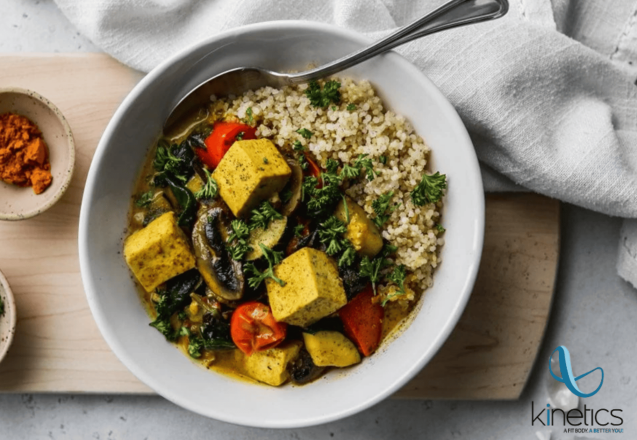

Tofu Coconut Curry (Vegan)

Tofu Coconut Curry (Vegan)

Courtesy of walderwellness.com

This warm, nourishing, plant-based meal is perfect for dinner or meal prep. It combines protein-rich tofu with colorful vegetables and a creamy spiced coconut curry sauce.


Ingredients

  • 1 block firm or extra-firm tofu 
  • 1 cup dry quinoa (or another whole grain) 
  • 1 Tbsp coconut oil, divided 
  • 3 cloves garlic, minced 
  • 3 cups cremini mushrooms, sliced or quartered 
  • 1 large bell pepper, chopped 
  • 2 small–medium zucchini, cut into ½-inch pieces 
  • 1½ cups cherry or grape tomatoes 
  • 3 cups baby spinach 
  • 1 can coconut milk 
  • 1½ Tbsp curry powder 
  • 1 tsp ground cumin 
  • ½ tsp ground cinnamon 
  • ½ tsp ground ginger 
  • Salt and pepper, to taste 
  • Optional garnish: lime wedges, fresh parsley or cilantro 


Instructions

1- Press the tofu by wrapping it in paper towels and placing something heavy on top to remove excess moisture. Then cut it into ½- to 1-inch cubes. 

2- Cook the quinoa (or grain of your choice) according to package directions. 

3- Heat half the coconut oil in a large pan over medium heat, add the minced garlic, and cook for a couple of minutes until fragrant. 

4- Add the mushrooms and sauté for about 5 minutes. Then add the chopped zucchini, bell pepper, and tomatoes, sautéing until the vegetables begin to brown, about 5–10 minutes. Stir in the baby spinach and cook until wilted. 

5- Pour the coconut milk over the cooked vegetables and stir in the curry powder, cumin, cinnamon, ground ginger, salt, and pepper. Bring the mixture to a boil. 

6- Gently stir in the tofu cubes, reduce the heat, and simmer uncovered for about 15–20 minutes so the sauce thickens and flavors meld. Taste and adjust seasonings as needed. 

7- Divide the cooked quinoa among bowls, spoon the coconut curry over top, and garnish with lime and fresh herbs if desired. Serve hot and enjoy! 


Nutrition facts per serving (1 bowl, 350 g, 12.3 oz):
Calories 395 kcal, Fat 23.1 g, Saturated Fat 14.8 g, Carbohydrates 37.1 g, Dietary Fiber 6.6 g, Sugars 7.2 g, Protein 14.6 g, Sodium 334 mg, Calcium 107 mg, Iron 4.2 mg, Potassium 798 mg, Vitamin C 63 mg.


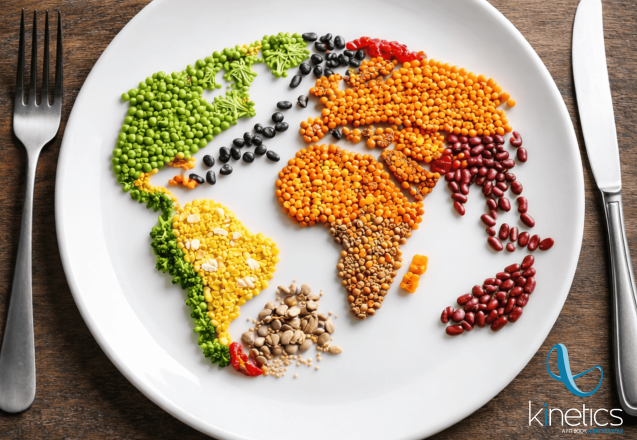
Fuel your body with intention: The Planetary Health Diet

Fuel your body with intention: The Planetary Health Diet


At Kinetics NJ, we talk a lot about training with intention. But what about fueling with intention?

Our food system is one of the largest drivers of climate change, biodiversity loss, freshwater depletion, and land degradation. So a global group of scientists and experts asked a powerful question: 


How can we eat in a way that supports human health and environmental sustainability at the same time?

The result: the Planetary Health Diet (PHD), developed by the EAT-Lancet Commission.

The PHD is not a restrictive “diet,” but a flexible science-backed framework designed to help people live longer, healthier lives — while reducing strain on the planet.


What Is the Planetary Health Diet?

Producing some foods requires significantly more planet resources than others.

For example:

  • Red meat production uses far more land and water than most legumes or grains.
  • Livestock farming contributes substantially to greenhouse gas emissions.
  • Monocropping and heavy fertilizer use degrade soil health and biodiversity.

The EAT-Lancet scientists concluded that without shifting global eating patterns, we risk exceeding the planet’s environmental limits — which threatens food security and public health long-term.


The Win-Win: Performance Meets Sustainability

The best part? They found that the diet that’s best for the Earth is also best for your body. The PHD aligns perfectly with nutritional strategies proven to reduce the risk of cardiovascular disease, Type 2 diabetes, and obesity.


What do these eating guidelines look like?

The PHD recommends a plant-rich, flexible diet that includes:

  • Vegetables and fruits – at least 5 portions a day
    • Whole grains – 3 to 4 portions a day
    • Legumes (beans, lentils, peas) – 1 portion a day
    • Nuts and seeds – 1 portion a day
    • Dairy (milk, yogurt, cheese) – one serving a day
    • Eggs – 3 to 4 a week
    • Poultry – 2 portions a week
    • Fish – 2 portions a week
    • Red meat – 1 portions a week

It’s not about eliminating food groups. It’s about rebalancing proportions.

Simple. Balanced. Sustainable.


It’s your turn

Small Shifts You Can Start This Week

You don’t need to overhaul your pantry overnight to make an impact. Try starting with these:

  1. Swap one red meat meal this week for lentils or beans.
  2. Add one extra serving of vegetables to dinner.
  3. Replace refined grains (like white rice or regular pasta) with whole grains like quinoa or brown rice  in one meal per day.

Consistency beats perfection.


Call to Action

At Kinetics NJ, we train for strength, resilience, and longevity — and nutrition is part of that equation.

If you’d like guidance on aligning your nutrition with your performance goals, reply to this email or send us a text at 732-314-3086. Whether through Personal Training or Small Group Training, we help you build systems — not just workouts — that support a fit, energized, and sustainable life.

Train hard.
Recover well.
Eat with purpose. 🌱


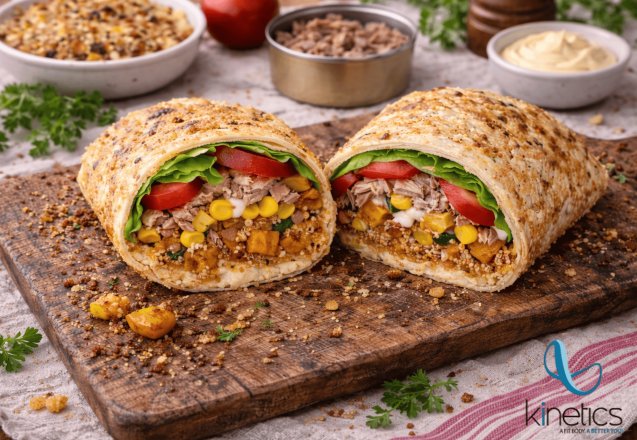
Crispy Quinoa & Tuna Wrap

Crispy Quinoa & Tuna Wrap

Courtesy of Kulinaria Recetas

Looking for a fresh twist on a classic burrito? Try this wrap for a satisfying crunch in every bite. It’s easy to make, packed with texture, and perfect for a weeknight dinner or grab-and-go lunch.

Ingredients

½ cup quinoa, well rinsed

3–4 slices of squash (like butternut or calabaza)

1 ear of corn (fresh kernels)

6 slices of your favorite melting cheese

1 can tuna (drained)

Lettuce leaves

Tomato, sliced

Mayonnaise (or your preferred creamy sauce)

Olive oil

Salt, pepper, oregano, and smoked paprika (to taste) 


Instructions

  1. In a pot, bring quinoa and water to a boil. Reduce heat and simmer, covered, until grains are tender and liquid absorbed (about 15 minutes). Set aside to cool slightly. 
  2. Heat a splash of olive oil in a skillet over medium-low heat. Add the squash cubes, season with salt, pepper, and your favorite spices, and sautÊ until lightly browned. Add the corn kernels and cook until warm and slightly charred. 
  3. On a silicone baking mat or parchment-lined baking sheet, arrange the cheese slices. Spoon the cooked quinoa on top and sprinkle with a pinch of oregano, smoked paprika, salt, and pepper. Bake or broil until the cheese and quinoa form a golden, crispy layer. Let cool slightly. 
  4. Toss the crispy quinoa-cheese layer on a an aluminum sheet. Top with sautÊed squash and corn, tuna, lettuce, and tomato. Add a smear of mayonnaise or your favorite creamy sauce. 
  5. Roll up tightly, slice in half if desired, and enjoy your crunchy, flavorful wrap while it’s still warm.

Nutrition facts per serving (1 wrap, 250 g, 8.8 oz):

Calories 382 kcal, Fat 18.6 g, Saturated Fat 6.5 g, Carbohydrates 31.9 g, Dietary Fiber 4.0 g, Sugars 2.8 g, Protein 23.4 g, Sodium 379 mg, Calcium 240 mg, Iron 2.8 mg, Potassium 620 mg, Vitamin C 16.6 mg.


Why Laughter Matters

Why Laughter Matters

When was the last time you had a really good laugh?

The kind that sneaks up on you. The kind that makes your face hurt, your shoulders relax, and your breath feel lighter.

Laughter doesn’t have to be loud or over-the-top to matter. Even a few moments of genuine laughter each day can gently shift our mood, energy, and mindset.

Why laughter matters

Laughter helps the body and mind reset in powerful ways:

  • It lowers stress hormones. Research shows that genuine laughter can reduce cortisol and epinephrine, helping the nervous system move out of “fight or flight” and into a more balanced, recovery-friendly state.
  • It boosts feel-good brain chemicals. Laughter increases endorphins and dopamine, which support motivation, mood regulation, and mental focus.
  • It supports clearer thinking. When stress decreases, attention, memory, and problem-solving abilities often improve.

Did you know?
Studies suggest that 10–15 minutes of laughter can increase heart rate, support vascular function, and burn some calories—similar to light physical activity—followed by a relaxation response that supports recovery.

So yes—laughing during a workout absolutely counts as functional movement 😉

Laughter connects people

Humans are wired for connection. Shared laughter builds trust, strengthens relationships, and creates a sense of belonging. Supportive group environments—like training spaces that encourage humor, encouragement, and shared effort—naturally invite these moments.

That sense of connection can be a powerful motivator, helping people stay consistent and actually enjoy the process, regardless of our starting points or abilities.


Your Laugh gentle challenge

  • Start small. Pause for a moment and allow a smile to form. Notice how it feels in the face and body. Even this simple action can positively influence mood—a concept known as the facial feedback hypothesis.
  • Make room for imperfection. Missing a step, losing balance, needing a modification, or feeling awkward during a workout is part of movement. Laughing it off can make the experience lighter and more enjoyable.
  • Notice the shift. Pay attention to how laughter changes the experience, even slightly. Those small moments add up.

Laughter isn’t about performance or doing things “right.” It’s about feeling human, connected, and supported.


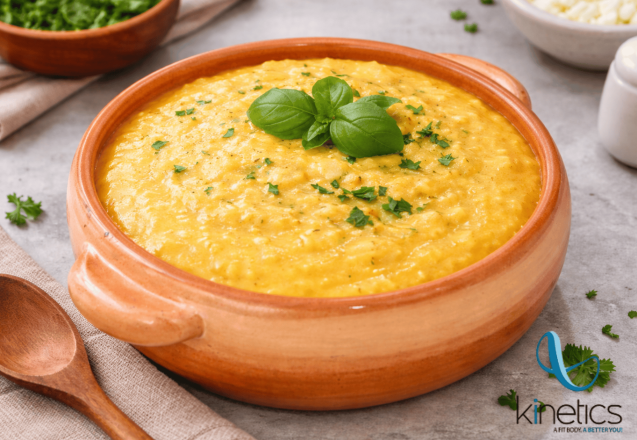
Humita en olla: Creamy Andean Corn & Squash Stew (Vegetarian)

Humita en olla: Creamy Andean Corn & Squash Stew (Vegetarian)

Courtesy of Paulina Cocina (adapted by Maite)

This comforting corn-based stew is inspired by traditional South American flavors, blending fresh corn, tender squash, and melted cheese into a rich, spoonable dish. Naturally sweet, savory, and deeply satisfying, it’s perfect as a cozy main course or a hearty side served straight from the pot.

Ingredients

  • 6 fresh corn, kernels removed
  • 2 scallions (green onions), finely sliced
  • 1 red bell pepper, finely diced
  • 1 yellow onion, finely chopped
  • 1 small squash (such as pumpkin or butternut), cooked and mashed
  • Fresh herbs, to taste (such as basil, parsley, or oregano)
  • 14 oz (300 g) fresh cheese, cut into cubes (mozzarella or any cheese that melts well)
  • Salt, to taste
  • Black pepper, to taste
  • Ground nutmeg, to taste
  • Olive oil
  • Milk, as needed (optional)

Instructions

  1. Grate the corn kernels or blend them in a food processor until smooth and creamy. Set aside.
  2. Cook the squash until tender, then mash into a smooth purĂŠe. Reserve.
  3. Heat the olive oil in a large pot over medium heat. Add the chopped onion and red bell pepper and cook until the onion becomes translucent.
  4. Stir in the sliced scallions. Season with salt and pepper, reduce heat to low, and cook gently for a few minutes.
  5. Add the blended corn to the pot and cook for about 5 minutes, stirring frequently.
  6. Mix in the squash purĂŠe, salt, pepper, nutmeg, and fresh herbs to taste.
  7. Continue cooking over low heat until the mixture thickens, about 10 minutes. If it becomes too thick, add a splash of milk to loosen it.
  8. Remove from heat and gently fold in the cubed fresh cheese, stirring until it begins to melt.
  9. Serve warm in small bowls, garnished with extra fresh herbs.


Nutrition facts per serving (1 cup, 245 g, 8.6 oz):

Calories 297 kcal, Fat 16.2 g, Saturated Fat 6.9 g, Carbohydrates 27.7 g, Dietary Fiber 4.4 g, Sugars 6.1 g, Protein 12.3 g, Sodium 355 mg, Calcium 255 mg, Iron 1.1 mg, Potassium 490 mg, Vitamin C 16.0 mg.


Fitness Goals + Tiny Habit Hacks = Sweat and Smiles

Fitness Goals + Tiny Habit Hacks = Sweat and Smiles

Fitness and Training

Empowering wellness through personalized training and nutrition.

Hi Friend,

It’s fitness goal season! It’s that magical time when we all imagine ourselves running marathons, lifting cars, or doing single arm handstands… (😂before reality reminds us that even walking up three flights of stairs is a challenge).

In this article I aim to help you set realistic fitness goals that actually stick—and include habit changes that make progress painless (or at least hilarious).


First, please start small

Skip the “I’ll do 100 burpees” mindset. Pick something achievable: a 10-minute walk, 5 push-ups, or stretching during Zoom calls. Small habits = big results over time. Whatever your starting place is, it’s all good!


Do fit your goals into your life

No 4 a.m. runs unless you like being attacked by alarm clocks. Your goals should match your energy, schedule, and your level of enthusiasm for sweating.


Build mini milestones

Mini goals + habit tweaks = magic.


Embrace setbacks, we ALL have them

Skipped a workout? That’s a “strategic muscle recharge day.” Forgot your water habit? “Hydration research postponed.” Humor keeps habits sustainable.


Celebrate all wins

Every habit counts. Did you stretch? Win. Drank water instead of soda? Win. Put on workout clothes and then binge-watched TV? Still a small victory.

Real fitness isn’t about perfection—it’s about tiny, consistent habit changes that actually fit into your life. Less guilt, more progress, and maybe even a little fun along the way.

Here’s to building habits that stick (and goals that don’t make us cry)! 💪😄


If you need more help figuring out how to make a realistic plan, REPLY TO THIS TEXT. Kinetics NJ wants to help you improve. 

Please share this with someone who needs it. 

High five,

Coach Metra
 

It’s Your Turn

Unlock your full potential with our fitness and nutrition programs.

Here is a fun challenge for you to try:

  • Swap one sugary drink a day for water (hydration level: expert)
  • Take stairs instead of the elevator (leg day without trying!)
  • Add a 2-minute stretch before bed (hello, limber glory)


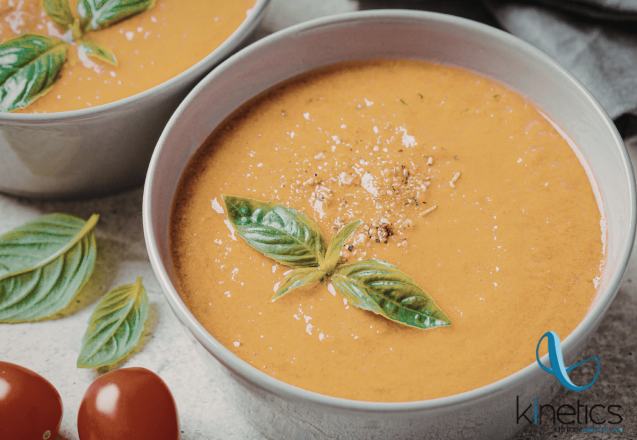
Creamy Tomato Basil Soup (Vegetarian / Vegan)

Creamy Tomato Basil Soup (Vegetarian / Vegan)

Courtesy of realfoodwithaltitude.com

This tomato basil soup is rich, comforting, and full of bright flavor from roasted tomatoes and fresh basil. Roasting the fresh tomatoes and onions deepens the sweetness, and the milk (or alternative of your choice) makes the texture luxuriously smooth. 


Ingredients

  • 4 beefsteak tomatoes (or other large tomatoes), quartered
  • 20 oz cherry tomatoes
  • 1 white onion, quartered
  • 2 tablespoons olive oil
  • 4 cups vegetable broth
  • 1 tablespoon Italian seasoning
  • 1 teaspoon dried parsley
  • 1 tablespoon minced garlic
  • 2 cups milk (or coconut milk or other plant-based milk for vegan alternative)
  • ½ cup fresh basil leaves
  • 2 teaspoons salt
  • 2 teaspoons black pepper
  • Âź teaspoon red pepper flakes (optional for heat) 


Instructions

  1. Preheat your oven to 425°F (220°C). Line a baking sheet with parchment paper. Place the quartered beefsteak tomatoes, cherry tomatoes, and white onion on the sheet. Drizzle with olive oil and season with 1 teaspoon salt and 1 teaspoon pepper. Roast about 35 minutes, until soft and lightly caramelized. 
  2. Transfer the roasted tomatoes and onion to a large pot. Add the remaining ingredients: vegetable broth, garlic, coconut milk (or alternative milk), Italian seasoning, dried parsley, red pepper flakes, fresh basil, salt, and pepper. 
  3. While still warm, blend until the soup is smooth and creamy. 
  4. Bring the mixture to a boil. 
  5. Reduce heat and simmer about 10 minutes, letting the flavors meld and the soup thicken slightly. 
  6. Taste and adjust seasonings as needed. Ladle into bowls and enjoy warm! 


Nutrition facts per serving (1 cup, 245 g or 8.6 oz):

Calories 89 kcal, Fat 4.4 g, Saturated Fat 1.3 g, Carbohydrates 10.5 g, Dietary Fiber 1.9 g, Sugars 6.7 g, Protein 3.2 g, Sodium 791 mg, Calcium 81 mg, Iron 0.6 mg, Potassium 409 mg, Vitamin C 18.7 mg.